



SBA Loans vs. Short-Term Business Loans: Key Differences
Your business needs financing. Maybe you’re replacing equipment, purchasing inventory, or preparing to take on more work. You know what the money would help you accomplish, but choosing a loan can feel less straightforward.
When comparing SBA loans vs. short-term business loans, start with three things: what you need to fund, when you need the money, and how repayment would fit into your cash flow.
Both options can serve a useful purpose. Understanding their differences can help you ask better questions and evaluate offers with more confidence.
First, can an SBA loan be a working capital loan?
Yes. Working capital describes what financing is used for, such as payroll, inventory, supplies, and other operating expenses. It does not identify one specific loan program.
An SBA loan can provide working capital. So can a non-SBA business term loan.
For this comparison, we’re focusing on SBA 7(a) loans and short-term, non-SBA business loans used to support operating needs.
What is an SBA 7(a) loan?
An SBA 7(a) loan is issued by a participating lender and partially guaranteed by the U.S. Small Business Administration. You apply through the lender, which handles your application and financing.
The program provides loans of up to $5 million for eligible uses, including working capital, equipment, real estate, certain debt refinancing, and business acquisitions. Businesses must meet program requirements and demonstrate a reasonable ability to repay.
The government guarantee reduces the lender’s risk and can help eligible borrowers access longer repayment terms and competitive rates. It does not remove the borrower’s responsibility to repay the loan.
Why businesses consider SBA financing
Longer repayment terms can make it possible to spread the cost of a substantial investment over time.
For many 7(a) loans, terms are generally 10 years or less, with exceptions for real estate and certain longer-lived equipment. Real estate financing can extend up to 25 years. The actual term depends on the purpose of the loan and applicable requirements.
SBA financing may be worth exploring when you have time to prepare an application and want to evaluate longer-term borrowing options.
What to consider before applying
The application requirements depend on the loan and the lender’s processing method. Ask for a document checklist early so you know what to prepare.
Also ask about the full timeline from application to receiving funds. A quoted approval or SBA review time may cover only one stage of the process. Underwriting, closing requirements, and missing information can affect when the money becomes available.
What is a short-term business loan?
A short-term business loan provides funds that you repay over a relatively short period according to an agreed schedule. Here, we’re referring to loans outside the SBA program.
Businesses may use these loans to purchase inventory, cover project materials, repair equipment, or manage a temporary gap between expenses and incoming revenue.
Loan amounts, repayment periods, rates, and eligibility requirements vary by lender. Review the actual offer rather than assuming all loans labeled “short-term” work the same way.
Why businesses consider short-term financing
Some online and alternative lenders offer streamlined applications and funding within days, subject to approval, verification, and required documentation.
That speed may matter when an expense has a firm deadline or an interruption is keeping your business from operating.
A shorter repayment period may also align with a defined business need. However, the expected benefit of a purchase needs to be considered alongside the payments required to finance it.
What to consider before applying
Short-term financing may carry higher interest rates or fees than an SBA loan. Payments may also be due more frequently, including daily or weekly.
A shorter term means less time to repay the amount borrowed. Even if each payment looks manageable, frequent payments can put pressure on the cash available for payroll, rent, suppliers, and other obligations.
The ability to receive funds quickly and the ability to repay comfortably are two separate questions.
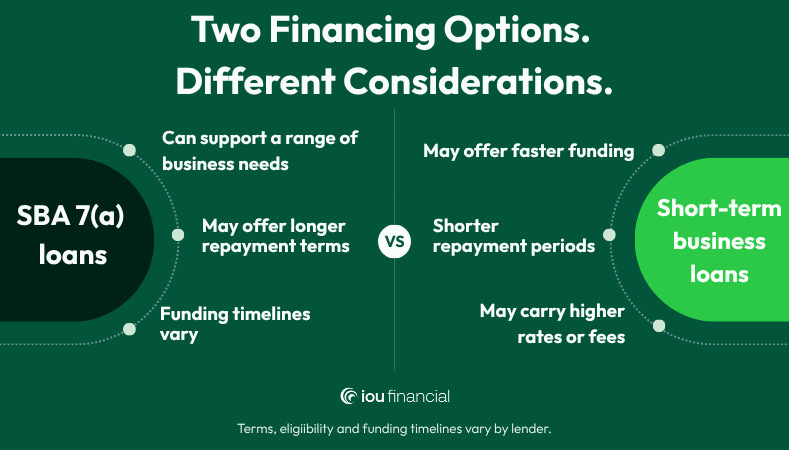
SBA loans vs. short-term business loans at a glance
| Consideration | SBA 7(a) loans | Short-term, non-SBA business loans |
|---|---|---|
| Uses | Working capital and a range of eligible business investments | Often operating expenses and near-term business needs; permitted uses vary |
| Funding process | Timing depends on the lender, application, and transaction | Some lenders offer funding within days after approval and verification |
| Repayment period | May offer longer terms based on the use of funds | Shorter repayment period specified in the offer |
| Payment schedule | Most 7(a) term loans have monthly payments | May include daily, weekly, or other schedules |
| Pricing | Subject to SBA program rules and lender terms | Determined by the lender and offer; rates or fees may be higher |
| Qualification | SBA eligibility requirements and lender underwriting | Lender-specific eligibility and underwriting |
Most SBA 7(a) term loans are repaid monthly. Payments on variable-rate loans may change when the interest rate changes. Always review the terms of your specific offer.
How to decide which financing fits your business
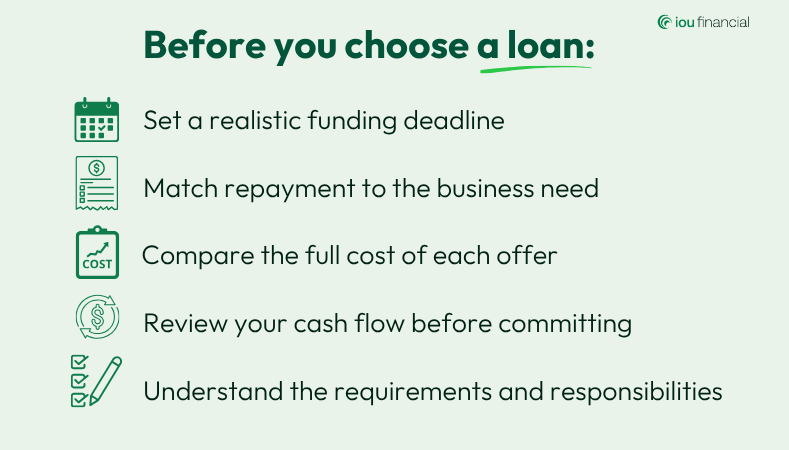
1. Set a realistic funding deadline
Identify when you need the money available—not simply when you want an approval.
If you’re planning a purchase months ahead, you have more time to explore financing options and prepare documents. If an essential repair is stopping operations, your available timeline may be much shorter.
Ask each lender:
- When could funds realistically be available?
- What information is needed before a decision?
- What steps remain after approval?
- What could delay funding?
This helps you compare timelines on the same basis.
2. Match repayment to the business need
Consider how long the purchase will benefit your business and when it may generate revenue or savings.
Equipment used for several years may warrant exploring a longer repayment period. Inventory for a specific season may create a shorter funding need.
Neither situation automatically determines the right loan. You still need to assess the payment schedule and account for uncertainty.
If sales arrive later than expected, would you have enough cash to make payments and cover regular expenses?
3. Compare the full cost of each offer
A small payment does not necessarily mean a low-cost loan. A higher interest rate does not automatically mean a higher total dollar cost when loan amounts and repayment periods differ.
For each offer, review:
- Net funds received: How much reaches your account after upfront deductions?
- Borrowing charges: What interest and fees apply?
- Total repayment: How much will you pay under the scheduled terms?
- Payment frequency: How often will money leave your account?
- Repayment period: How long will the obligation last?
- Early repayment terms: Would paying early reduce the cost, and would any charges apply?
If an offer uses a pricing measure you don’t understand, ask the lender to explain it in dollars and, where available, as an annual percentage rate. Different pricing labels should not be treated as directly interchangeable.
4. Review your cash flow before committing
Look beyond whether you can afford the first payment.
Map expected customer receipts against payroll, rent, supplier bills, existing debt payments, and the proposed new payment schedule. Consider a slower-than-expected period as well as your normal forecast.
If borrowing would cover a recurring shortfall without addressing its cause, review the underlying issue before adding another obligation. Pricing, expenses, customer payment delays, or weak demand may need attention alongside any financing decision.
5. Understand the requirements and responsibilities
Ask each lender which qualifications apply and what documents it needs. A shorter application does not mean approval is automatic.
Before signing, understand any personal guarantee, collateral requirement, or restriction on additional borrowing. Ask questions about unfamiliar language and seek professional guidance when needed.
Can a business use both types of financing?
A business may use SBA financing for one need and a short-term loan for another over time.
If you already have financing outstanding, check your existing agreement before taking on more debt. Additional borrowing may be restricted or require consent.
Also evaluate the combined payments. A new loan that looks manageable on its own may be harder to support alongside current obligations.
Frequently asked questions
Are SBA loans only for major purchases?
No. SBA 7(a) financing can also support working capital. The permitted use and structure depend on the program and the loan.
Are short-term business loans always faster?
It depends. Some lenders offer fast funding, but timing depends on approval, documentation, verification, and closing requirements. Ask when funds could actually be available. At IOU our streamlined online application takes just minutes, with approvals and funding in as little as 24 hours.
Is an SBA loan always the cheaper option?
Not automatically. SBA financing can offer competitive pricing, but the total cost depends on the amount borrowed, rates, fees, and repayment period. Compare specific offers rather than relying on the loan category.
Does a shorter repayment period mean smaller payments?
No. Repaying a comparable amount over less time can require larger payments or more frequent payments. Review both the payment amount and the schedule.
Find financing that works beyond funding day
Choosing financing means considering what happens after the money reaches your account. The loan should support a clear business purpose, meet a realistic timeline, and have payments your cash flow can handle.
If you’re exploring working capital financing, IOU Financial’s team can discuss your business needs, timeline, and available loan options.
Visit IOU Financial to learn more about business term loans.
This article is for educational purposes only and does not constitute financial, tax, or legal advice. Loan approval, funding timelines, rates, fees, and terms vary by lender and borrower qualifications. Consult a qualified advisor about your circumstances and visit sba.gov for current SBA program information.