



How to Run a Small Business Promotion Without Giving Away Your Profit
Small Business Saturday is November 28, 2026. Here’s how to run a promotion that fills your store and your bank account.
TL;DR: A small business promotion is profitable only if the extra sales it generates cover the margin you give up. Know your gross margin before you pick a discount, favor bundles, gifts with purchase, and spend thresholds over blanket percent-off deals, set a firm budget and end date, and plan your cash flow before the rush hits. Track results so next year’s promotion is smarter than this year’s.
Small Business Saturday is coming up on November 28, and for many owners it’s the biggest chance of the season to bring in new customers. The temptation is obvious: slash prices, put up a big sign, and hope volume makes up the difference. But running a small business promotion without giving away your profit takes more than a flashy discount. It takes a clear view of your numbers before you announce a single deal.
This guide walks through how to price a promotion, which offers protect your margins, and how to make sure the cash is there to support the rush, so a busy Saturday turns into a profitable one.
What Is Small Business Saturday, and Why Does It Matter for Promotions?
Small Business Saturday is the shopping day held each year on the Saturday after Thanksgiving, encouraging shoppers to buy from independent local businesses. It was launched by American Express in 2010 and now sits between Black Friday and Cyber Monday as a fixture of the holiday season. In 2026 it falls on Saturday, November 28.
For small business owners, that matters for one reason: shoppers are actively looking for you. You don’t have to create the demand. You have to convert it without discounting so deeply that you lose money on every sale.
How Do You Run a Promotion Without Losing Money?
To run a promotion without losing money, calculate your gross margin first, choose an offer that costs you less than the extra sales it brings in, and set a budget, a time limit, and a success target before you launch. Every discount is a cut to your margin, so the question is never “how big a deal will draw a crowd?” It’s “how many extra sales do I need to come out ahead?”
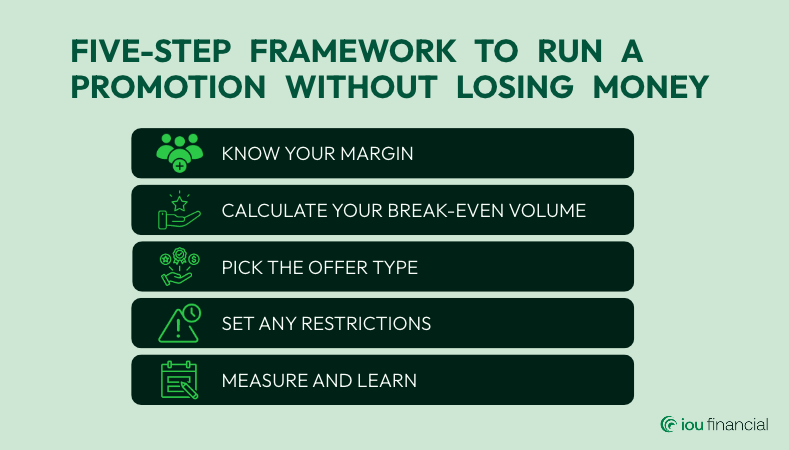
Follow this five-step framework:
- Know your margin. Gross margin is (price − cost of goods or direct service cost) ÷ price.
- Calculate your break-even volume for the discount you’re considering (see the math below).
- Pick the offer type that protects the margin best.
- Set guardrails: a start and end date, an inventory cap, and a promotion budget.
- Measure and learn so the next promotion improves on this one.
How Much Can You Discount Before You Lose Profit?
The answer depends entirely on your gross margin, and the math is more sobering than most owners expect.
Say you sell a product for $50 that costs you $30 to make or buy. Your gross profit is $20 per sale, a 40% margin.
- Offer 20% off: the price drops to $40, and your profit per sale falls to $10. You’ve cut your profit in half, so you must sell twice as many units just to earn the same total profit.
- Offer 10% off: profit per sale falls to $15, so you need about 33% more sales to break even.
Here’s the formula you can use for your own numbers:
Extra sales needed to break even = Discount % ÷ (Gross margin % − Discount %)
| Gross margin | 10% off | 15% off | 20% off | 25% off |
| 40% | +33% sales | +60% sales | +100% sales | +167% sales |
| 50% | +25% sales | +43% sales | +67% sales | +100% sales |
| 60% | +20% sales | +33% sales | +50% sales | +71% sales |
If you don’t believe a 25% discount will nearly triple your sales on a 40% margin, don’t offer it. And remember that these figures cover gross profit only. Extra staffing, packaging, card fees, and rushed shipping all eat into what’s left.
What Are the Best Promotion Ideas That Protect Your Margins?
The best promotions add perceived value without cutting your price across the board. Offers that reward customers for spending more, buying more, or coming back protect your margins better than blanket percent-off sales.
- Bundles. Package a popular item with a slower mover at a combined price. You move inventory you’d otherwise discount later, and customers see a deal.
- Spend thresholds. “Spend $75, get $15 off” or “free shipping over $60” lifts your average order value, so the discount is funded by a bigger basket.
- Gift with purchase. A small, low-cost extra (a sample, a tote, a handwritten thank-you) feels generous but costs far less than a price cut.
- Loyalty and early access. Reward your existing customers with first pick or a members-only perk. They’re cheaper to convert than strangers and more likely to return.
- Gift cards with a bonus. Offer a $10 bonus card with a $50 purchase. You collect cash now, the bonus only costs you if it’s redeemed, and it brings customers back through the door in January, when sales are typically slow.
- Limited-quantity or limited-time offers. Real scarcity drives action without needing a deeper discount.
- Partnerships. Team up with a neighboring business for a joint offer or a cross-promotion. You share the cost and reach each other’s customers.
Be careful with: deep percent-off sitewide sales, “buy one, get one free” on thin-margin items, and promotions with no end date. They train customers to wait for the next sale.
How Do You Plan Cash Flow Before a Big Promotion?
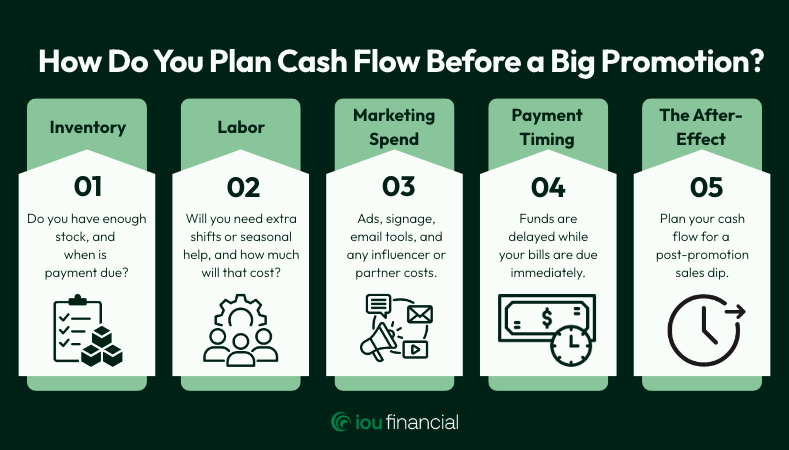
Plan cash flow for a promotion by estimating what you’ll spend before the revenue arrives, including inventory, staffing, marketing, and fees, and confirming you can cover it. A successful promotion can still strain your finances if the costs land before the cash does.
Before you launch, map out:
- Inventory: Can you stock enough to meet demand, and when do suppliers need to be paid?
- Labor: Will you need extra shifts or seasonal help, and how much will that cost?
- Marketing spend: Ads, signage, email tools, and any influencer or partner costs.
- Payment timing: Card processors and online platforms often hold funds for a few days, while your supplier and payroll bills come due on schedule.
- The after-effect: Sales often dip right after a big promotion. Make sure you can ride out the slower week.
This is where profitable businesses get caught. Growth consumes cash. If your plan shows a gap between when you pay for the rush and when you get paid from it, short-term working capital can help bridge it. Options like a working capital loan or a business line of credit can cover inventory and staffing up front, so you can say yes to demand instead of turning customers away. Just compare the total cost of any financing against the profit the promotion is projected to generate, and only borrow if the numbers clearly work.
How Do You Know If Your Promotion Worked?
A promotion worked if profit, not just sales, went up compared with a normal period. Revenue alone can mislead you. A busy day with razor-thin margins can leave you worse off than a quiet one.
Track these numbers for every promotion:
- Total sales vs. a typical comparable day or week
- Gross profit after the discount and any promotion costs
- Average order value
- New vs. returning customers
- Redemption rate for coupons, codes, or gift card bonuses
- Return on promotion spend: (extra gross profit − promotion costs) ÷ promotion costs
Write down what you learned the same week while it’s fresh. Which offer drove the most profit? Which product sold out? Which customers came back? That one-page recap becomes your playbook for the next holiday.
Your Small Business Saturday Promotion Checklist
You have time before November 28. Use it:
- Calculate your gross margin on the products or services you plan to feature.
- Pick one or two offers from the list above instead of discounting everything.
- Set a maximum discount budget and a hard end time.
- Confirm inventory, staffing, and the cash to pay for both.
- Announce early through email, social media, and in-store signage, and tell your existing customers first.
- Prepare a simple tracking sheet so you can measure results the same day.
- Plan a follow-up (a thank-you email, a January offer) to turn first-time shoppers into regulars.
Frequently Asked Questions
What is a good profit margin for a small business promotion?
There’s no universal number, but your promotion should leave you with a positive gross profit after discounts and costs. Businesses with margins under 40% have little room for deep discounts. Use the break-even formula above to find out how many extra sales a given discount requires.
Is it better to offer a discount or a free gift?
A free gift usually protects your margin better. A small add-on has a fixed, low cost, while a percent-off discount reduces the profit on every item in the order. Gifts with purchase also encourage larger baskets.
When is Small Business Saturday in 2026?
Small Business Saturday 2026 is on Saturday, November 28, the Saturday after Thanksgiving.
How far in advance should I plan a promotion?
Aim for at least two to four weeks. That gives you time to run the numbers, order inventory, schedule staff, and build awareness through email and social media.
How can I fund a promotion if cash is tight?
Start by negotiating payment terms with suppliers and pre-selling through gift cards. If you still have a gap between costs and revenue, short-term financing such as a working capital loan or business line of credit can help, as long as the projected profit comfortably exceeds the cost of borrowing.
How do I avoid training customers to wait for sales?
Keep promotions limited and predictable, such as one or two big moments a year. Lean on value-adds like bundles, early access, and gifts instead of constant price cuts, and always attach a real deadline.
The Bottom Line
The best small business promotions aren’t the biggest discounts. They’re the ones built on your real numbers. Know your margin, choose offers that add value without gutting your price, make sure the cash is there to support the rush, and measure what happens. Do that, and Small Business Saturday becomes more than a busy day. It becomes a profitable one.
Need working capital to prepare for the busy season? See if you qualify for flexible financing from IOU Financial.