



Business Loan Payments Daily vs. Weekly vs. Biweekly: Which Schedule Fits Your Cash Flow?
TL;DR
Business loan payments frequency—daily, weekly, or biweekly—shapes how repayment fits into your day-to-day cash flow. When comparing the same total repayment amount over the same term, daily payments are generally smaller and more frequent; weekly and biweekly payments are larger but spaced further apart. No schedule is inherently better. The right fit depends on when your business collects revenue, when other major expenses are due, and how the full repayment terms compare.
When business owners compare financing offers, much of the attention goes to two things: how much they can borrow and how fast the funds arrive. But another detail deserves careful consideration: how often you’ll make payments.
Depending on the lender and product, business loan payments may be collected daily, weekly, biweekly, or monthly. IOU Financial offers daily, weekly, or biweekly payment options for its term loans. Other products work differently. Most SBA 7(a) term loans, for instance, are repaid monthly, according to the U.S. Small Business Administration.
Choosing a schedule starts with understanding how money actually moves through your business.
What Are Daily Business Loan Payments?
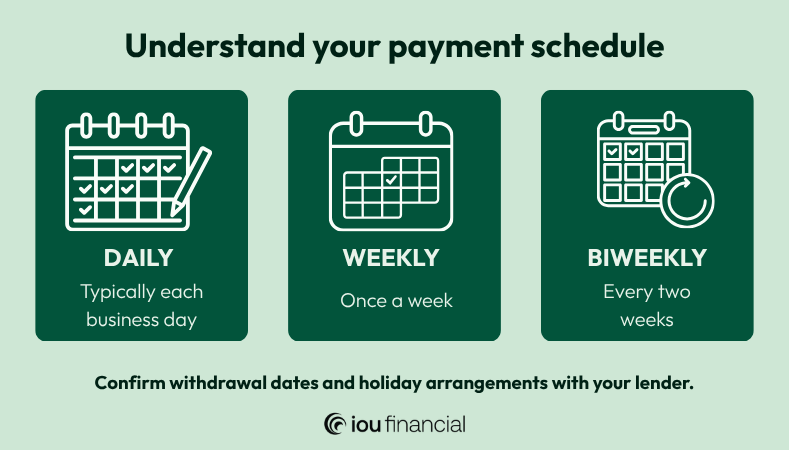
With a daily schedule, a payment is typically withdrawn each business day. Confirm the exact withdrawal days and holiday arrangements with your lender.
When the total repayment amount and term are the same, spreading repayment across more payments generally makes each withdrawal smaller than it would be under a weekly or biweekly schedule.
A daily schedule may fit businesses that receive consistent deposits throughout the week. What matters is when funds become available in the account, not simply when sales occur.
The trade-off is less time between payments. Businesses with inconsistent deposits or long gaps between customer payments need to consider whether their available balance can support frequent withdrawals alongside other expenses.
What Are Weekly Business Loan Payments?
A weekly schedule typically involves one payment on a designated day each week. This gives a business more time to collect revenue between withdrawals, but each payment is generally larger than a comparable daily payment.
Weekly schedules may fit businesses that receive customer payments on a predictable weekly basis. Fewer withdrawals can also make the payment schedule easier to track.
Weekly doesn’t automatically mean easier, though. A larger payment can create pressure if it falls close to payroll, rent, an inventory order, or another major expense.
What Are Biweekly Business Loan Payments?
Biweekly means a payment every two weeks. That differs from twice-monthly payments: biweekly schedules typically produce 26 payments per year, while twice-monthly schedules produce 24. Confirm the actual dates and number of payments in your agreement.
Among daily, weekly, and biweekly schedules, biweekly provides the most time between withdrawals. When the total repayment amount and term are the same, individual payments are generally the largest of the three.
This structure may suit businesses with predictable collections every two weeks, provided each payment leaves enough cash available for payroll and other expenses.
Does Payment Frequency Change the Cost of the Loan?
Payment frequency alone doesn’t tell you whether a loan is cheaper.
Depending on how interest is calculated and the loan is structured, payment timing can affect total interest. Different offers may also have different rates, fees, and repayment terms.
To compare offers, review:
- The amount financed and the funds you actually receive after any upfront deductions
- The amount of each payment
- The total number of payments
- The repayment frequency and term length
- Interest and fees
- The total repayment amount
- Late-payment or insufficient-funds charges
- Whether early repayment changes what you owe
A smaller daily payment can look more manageable than a larger weekly payment. But that comparison only becomes useful once you consider how many payments you’ll make, how long repayment lasts, and what the financing costs overall.
5 Questions to Choose the Right Payment Schedule
Before accepting a schedule, look at when revenue actually reaches your bank account.
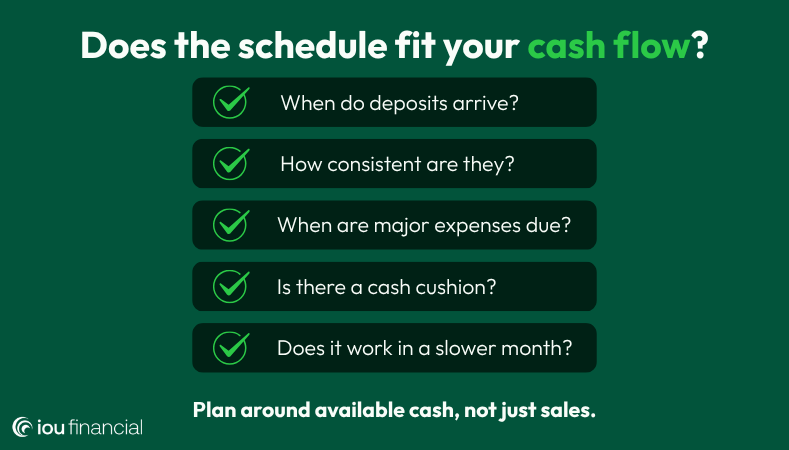
1. How often does the business receive money?
A restaurant might receive frequent deposits, while a contractor might wait weeks for a client to pay. Review your actual deposit history to understand the timing and size of incoming payments.
2. How consistent are those deposits from week to week?
Look at slow weeks as well as strong ones. A payment that feels comfortable during a busy stretch may be harder to manage when demand dips or customer payments arrive late.
3. When are your other major expenses due?
Payroll, rent, supplier invoices, taxes, insurance, and subscriptions all draw from your available cash. Place proposed loan payments on the same calendar so you can identify days when several obligations overlap.
4. Is there a cushion for the unexpected?
Consider how much cash would remain after loan payments and regular expenses. Would the business still have room for a repair, a slower week, or a delayed customer payment?
5. Does repayment still work under a conservative forecast?
Test the schedule against a below-average month. Map your starting cash balance, expected deposits, operating expenses, and proposed loan withdrawals by date. A positive month-end balance can still hide a shortfall earlier in the month.
The Bottom Line
Daily, weekly, and biweekly payments can each work for the right business. The important question is whether the full repayment structure aligns with your cash flow and leaves enough room for your other obligations.
Before signing, review the complete offer, ask your lender to explain anything unclear, and test the payments against a realistic cash-flow forecast.
Have questions about how repayment could fit into your business’s cash flow? Connect with IOU Financial to discuss your financing options.
This article is for general informational purposes only and does not constitute financial, legal, or tax advice.
FAQ
What’s the difference between daily, weekly, and biweekly business loan payments?
Daily payments are typically smaller and withdrawn each business day; weekly payments are larger and withdrawn once a week; biweekly payments are generally the largest of the three and withdrawn every two weeks — assuming the same total repayment amount and term. The right schedule depends on how your business collects revenue, not just which payment looks smallest.
Does “biweekly” mean twice a month?
No. Biweekly means every two weeks, which typically produces 26 payments a year. Twice-monthly schedules produce 24. Confirm the actual dates and number of payments in your agreement, since the two aren’t interchangeable.
Is a daily payment schedule cheaper than a weekly or biweekly one?
Not necessarily. Payment frequency alone doesn’t determine total cost — depending on how interest is calculated, payment timing can affect it, but rates, fees, and term length vary by offer. Compare the total repayment amount and full terms before assuming one schedule costs less.
How do I know which payment schedule fits my business?
Look at how often and how consistently your business actually receives deposits, when your other major expenses are due, and whether the schedule still works when tested against a below-average month rather than your best one.