



How to Build a Seasonal Business Budget in 5 Steps
TL;DR
A seasonal business budget helps you turn a few busy months of income into a full year of stability. To build one: (1) review last year’s bank statements to find your cash highs and lows, (2) split fixed bills from flexible costs, (3) pad your expense estimates by about 10%, (4) time big purchases around when revenue actually arrives, and (5) move a share of peak-season profit into a separate off-season fund right away. If your budget shows a gap, working capital can help bridge it.
Why a Seasonal Business Budget Matters
A seasonal business budget is a spending and savings plan built around uneven income. Instead of assuming your revenue looks the same every month, it maps out your busy season, your slow season, and the cash you need to get from one to the next.
Landscaping crews, tax preparation firms, boutique holiday shops, and many other small businesses know the pattern well. For a few months, sales are up, the team is working overtime, and cash is flowing. Then the off-season hits, and you have to stretch those earnings until the next rush.
That is why budgeting for seasonal income is less about tracking numbers and more about survival. A solid plan does the heavy lifting for you, so the slow months do not turn into stressful ones.
The good news: you do not need a finance degree or complicated software. Here are five simple steps to build a budget that works.
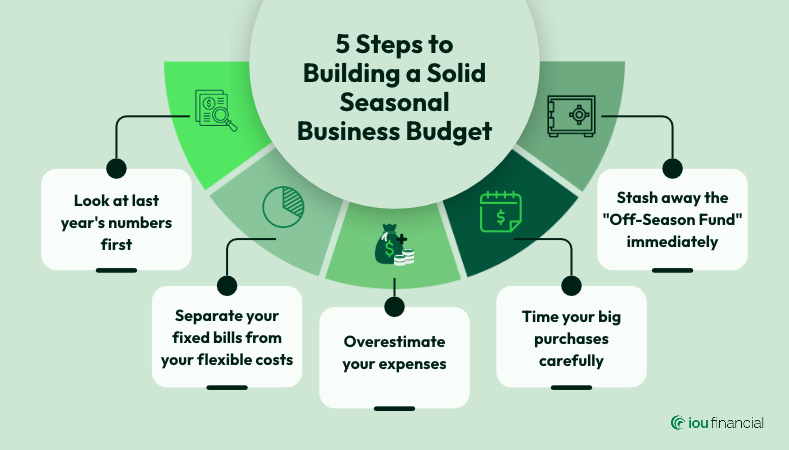
Step 1: Look at Last Year’s Numbers First
The best way to predict this year is to study what happened last year. Pull your bank statements from your busiest and slowest months, then ask two questions:
- When did the most money come in?
- When did the most money go out?
Those high and low points give you the baseline for your new budget. Pay attention to the gap between them. Cash often goes out before it comes in, and spotting that pattern early is the foundation of good seasonal business cash flow planning.
Step 2: Separate Fixed Bills From Flexible Costs
Next, write your expenses in two columns.
- Fixed bills stay the same whether you have 100 customers or zero. Think rent, insurance, and basic utilities.
- Flexible costs rise and fall with how busy you are, such as extra inventory, seasonal staff, or holiday marketing.
Your fixed bills are your “must-pay” total. That number tells you exactly how much cash you need to survive the off-season, which makes it one of the most important figures in your whole budget.
Step 3: Overestimate Your Expenses (Just a Little)
Things tend to break when you are busiest. A delivery truck needs new tires, the AC goes out in the middle of summer, or supply costs suddenly jump.
When you map out what you expect to spend this season, pad your expense budget by about 10%. It is far better to be pleasantly surprised by extra cash than caught off guard by an emergency bill.
Step 4: Time Your Big Purchases Carefully
One of the biggest traps for seasonal businesses is paying for inventory or extra staff before seasonal revenue starts coming in.
Build a timeline. For example, if you have to buy holiday inventory in October but will not see the profits until December, you need cash set aside to bridge that two-month gap. Mapping purchases against your expected revenue dates keeps a timing problem from becoming a cash crunch.
Step 5: Fund Your Off-Season Immediately
When money is pouring in during peak season, it is tempting to spend it on expanding or upgrading. Before you buy anything new, take a percentage of your peak profits and move it into a separate savings account.
Treat this off-season fund like a mandatory bill. When the slow months arrive, it is what pays your rent and keeps the lights on without the stress.
The Bottom Line
A great budget puts you in the driver’s seat and takes the guesswork out of your cash flow.
Still, running a business means the unexpected will eventually happen. A big bulk-inventory discount might pop up, a critical piece of equipment might fail mid-rush, or you might need to double your staff by next week.
If your budget shows you may need a little extra capital to bridge the gap this season, IOU Financial can help you explore your options.
Frequently Asked Questions
What is a seasonal business budget?
A seasonal business budget is a financial plan that accounts for uneven income across the year. It tracks your peak-season revenue, your off-season expenses, and the savings needed to cover the slow months.
How do I create a seasonal business budget with seasonal income?
Start by reviewing last year’s bank statements to find your highest and lowest cash months. Then separate fixed bills from flexible costs, pad your expense estimates by about 10%, time large purchases around revenue, and set aside a portion of peak profits in an off-season fund.
What is an off-season fund?
An off-season fund is a separate savings account that you fill with a percentage of your peak-season profits. It is meant to cover fixed costs like rent, insurance, and utilities during slow months, and it works best when you treat contributions like a mandatory bill.
How much should I save during my busy season?
There is no single right number. A helpful starting point is your “must-pay” total of fixed bills multiplied by the number of slow months you expect. From there, set a percentage of peak profits to move into savings so you reach that target by the end of the season.
Why should I overestimate expenses in my budget?
Unexpected costs, like equipment repairs or sudden supply price increases, often hit during your busiest weeks. Padding your expense budget by about 10% gives you a cushion so surprises do not derail your cash flow.
What are fixed bills versus flexible costs?
Fixed bills, such as rent, insurance, and basic utilities, stay the same no matter how many customers you have. Flexible costs, such as extra inventory, seasonal staff, and holiday marketing, change based on how busy you are.
What if I need cash before my busy season starts?
Many seasonal businesses have to pay for inventory or staff before revenue arrives. If your budget shows a gap, a working capital option may help bridge it. You can explore your options with IOU Financial.
This article is for general educational purposes and is not financial, legal, or tax advice. Financing is subject to credit approval and applicable terms.