



Unexpected Small Business Expenses: 7 Costs to Plan For
TL;DR: Many unexpected small business expenses aren’t completely unpredictable. They simply fall outside the normal monthly routine. Quarterly taxes, annual renewals, insurance changes, equipment repairs, software subscriptions, seasonal orders, and employee turnover often follow some kind of schedule. The solution isn’t guessing better; it’s putting known due dates on a calendar, reviewing the next 90 days regularly, and building in room for costs that shift. If a gap still shows up, understand the amount, timing, and repayment impact before deciding whether financing makes sense.
Unexpected small business expenses rarely announce themselves. A walk-in cooler fails before the weekend rush. A contractor’s truck breaks down as a project begins. A software renewal hits the same week payroll and supplier invoices are due.
The exact timing may be impossible to predict, but many of these costs can still be planned for. Here are seven expenses that commonly catch small business owners off guard—and practical ways to prepare before they become urgent.
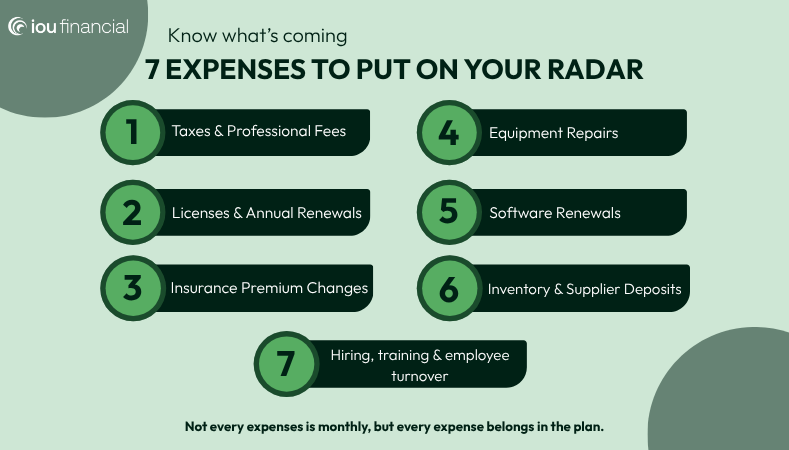
1. Quarterly Taxes and Professional Fees
Tax obligations don’t run on the same monthly rhythm as the rest of the business, which is exactly why they’re so easy to under-budget for.
Depending on how the business is structured, owners may owe estimated tax payments, payroll taxes, sales taxes, annual filing fees, or other federal, state, and local obligations. The IRS notes that many people who are in business for themselves generally need to make estimated tax payments — but the specifics depend heavily on the business and the owner’s situation.
Professional fees add a second layer. Bookkeeping cleanup, tax prep, legal reviews, payroll support, and year-end accounting work don’t happen every month, but they still need a line in the plan.
Prepare now:
- Ask your accountant or tax professional exactly which payments and filings apply to your business.
- Put every known due date on one calendar.
- Estimate professional fees before tax season or year-end work begins.
- Consider automatically moving a set percentage of revenue into a separate tax account year-round.
You don’t need to become your own tax expert. You just need to stop treating money that’s already spoken for as if it’s available operating cash.for changes. Build in room for the version of this project that doesn’t go perfectly.
2. Licenses, Permits, and Annual Renewals
A vehicle registration lapses. A professional certification expires without anyone noticing. A domain name renews at triple the promotional price it launched at. None of these are large expenses on their own — the problem is when three or four land in the same month, or when a missed deadline creates a late fee, extra paperwork, or a gap in the business’s ability to legally operate.
Requirements vary widely by location and industry. The U.S. Small Business Administration recommends checking the requirements that apply to your business and location, since licenses and fees can differ from one place to the next.
Prepare now:
- Build a master list of every license, permit, registration, and professional membership the business holds.
- Record the renewal date, expected cost, responsible person, and contact info for each.
- Set reminders 60 and 30 days out.
- Check whether renewal requires supporting documents, inspections, or continuing education, since those take time too.
A renewal notice arriving in the mail is not a system. A calendar you control is. this way helps you see the timing gap before it begins putting pressure on regular expenses.
3. Insurance Renewals and Premium Changes
Insurance itself isn’t a surprise —the renewal amount is. General liability, workers’ comp, commercial auto, property, and cyber coverage can all shift as a business grows. More payroll, new employees, added equipment, a claim from last year, or a new location can each push the premium up without much warning.
Some policies are also audited using actual business data from the prior period. If the estimates used at the start of the year came in low, an additional bill can show up months later, well after the original budget was set.
Prepare now:
- Review renewal dates and policy limits before the final notice arrives, not after.
- Ask your agent directly what could move the premium this year.
- Keep payroll, revenue, vehicle, and equipment records current so estimates stay accurate.
- Get quotes early enough to actually compare coverage.
- Budget for the real possibility that this year costs more than last year.
The cheapest premium isn’t automatically the right one if it stops covering the risks the business actually has.
4. Equipment Maintenance and Emergency Repairs
Equipment has a habit of failing at the worst possible moment — the walk-in cooler before a busy weekend, a contractor’s truck the morning a job starts, a payment terminal the second a line forms at the register.
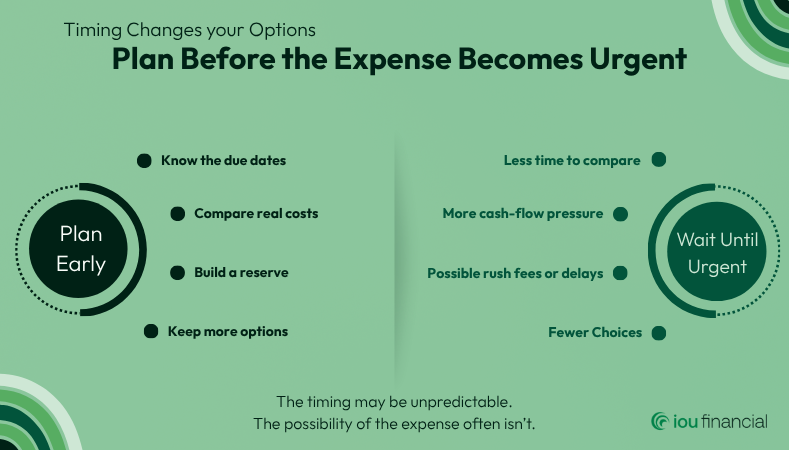
The exact day of failure can’t be predicted. But most essential equipment has a known age, an expected lifespan, and a maintenance schedule, which means the possibility of a repair can often be planned for, even if the timing can’t.
Among unexpected small business expenses, equipment failures can be especially disruptive when one machine, vehicle, or system is responsible for a large share of the business’s revenue.
Prepare now:
- List the equipment the business genuinely cannot operate without.
- Record its age, service history, warranty status, and past repair costs.
- Ask a service provider what a typical repair or replacement runs today, not five years ago.
- Schedule preventive maintenance before the business’s busiest stretch.
- Build a repair reserve and know your backup rental or service options in advance.
If equipment is already showing warning signs, putting off maintenance might preserve cash this month, but it usually trades a smaller bill now for a much larger one later.
5. Software Subscriptions and Automatic Renewals
Software costs rarely arrive as one big expense. They creep. A scheduling tool here, a design app there, an accounting platform added two years ago that nobody’s revisited since; each one renews quietly, often with a price increase or a handful of unused employee seats nobody remembered to remove.
Individually, none of it looks alarming. Added up on one statement, it often is.
Prepare now:
- Pull the last 12 months of bank and credit card statements and flag every recurring software charge.
- Record the owner, purpose, renewal date, and cancellation window for each tool.
- Remove former employees and unused seats immediately, not at the next renewal.
- Compare monthly versus annual pricing before renewing anything.
- Cancel tools that duplicate another platform or no longer serve a clear purpose.
A 15-minute quarterly subscription review is one of the easiest ways to turn a forgotten expense into real savings.
6. Seasonal Inventory, Supplier Deposits, and Shipping
Seasonal demand creates a cash-flow problem long before it creates revenue. A retailer places a large order months ahead of the holiday rush. A restaurant stocks up on ingredients and packaging before summer traffic picks up. A contractor pays a material deposit before a job even starts.
Across industries, the real cost may run higher than the original quote once supplier price changes, minimum order sizes, rush fees, storage, and shipping are added in. This is one of the most common timing traps behind unexpected small business expenses: the revenue is expected, but the bill comes first.
Prepare now:
- Review last year’s sales and purchasing records for the same season.
- Confirm current pricing, deposit requirements, order deadlines, and delivery windows directly with suppliers.
- Build freight, storage, packaging, and rush costs into the estimate from the start.
- Prioritize proven sellers and essential materials over speculative purchases.
- Map every payment due date against when the related revenue is actually expected to land.
If the timing doesn’t line up, look for ways to close the gap. Options include placing a smaller initial order, arranging staged deliveries, requesting customer deposits, or negotiating extended supplier terms.
7. Hiring, Training, and Employee Turnover
The cost of a new hire doesn’t stop at the first paycheck. Job postings, recruiting, background checks, onboarding, equipment, software access, payroll taxes, and training time all add up. A new employee may also need time to reach full productivity, while another team member may spend part of the workday training them.
Turnover makes this worse, especially when it happens with little warning and an essential role needs to be filled fast.
Prepare now:
- Calculate the full cost of an employee’s first 30 days, not just their wages.
- Keep job descriptions, training materials, and onboarding checklists ready to go, not written from scratch each time.
- Cross-train staff on the responsibilities that would hurt most if one person left suddenly.
- Identify which roles would be hardest to cover on short notice.
- Factor seasonal hiring and overtime into cash-flow planning before demand actually spikes.
Good preparation won’t stop someone from resigning. It just keeps the financial and operational hit from turning into a crisis.
Unexpected Small Business Expenses Don’t Automatically Mean You Should Borrow
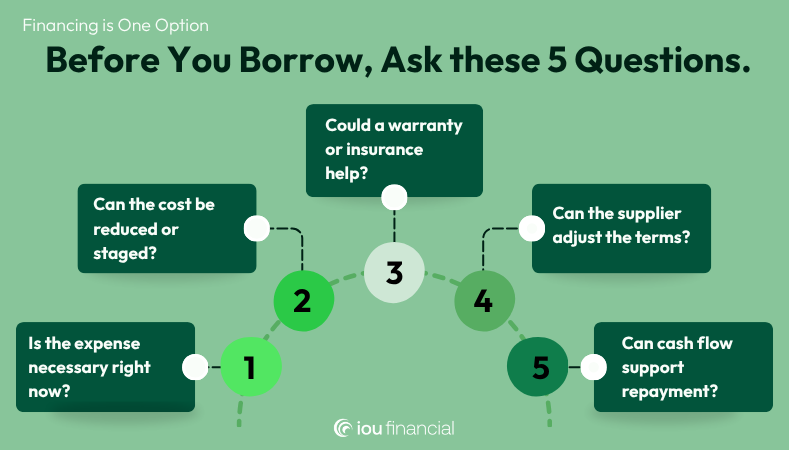
When unexpected small business expenses show up, financing is one option — but it shouldn’t be the reflexive first move. Before borrowing, it’s worth asking a few questions:
- Is this expense truly necessary right now, or can part of it wait?
- Could it be reduced or handled in stages instead of all at once?
- Does a warranty, insurance policy, or service agreement already cover part of the cost?
- Would the supplier offer a payment plan or different terms?
- Is there cash on hand that covers this without putting payroll, inventory, or supplier relationships at risk?
If the answer points toward financing, the next question is simple: will cash flow comfortably support the repayment schedule, not just cover it? That means comparing the total cost, fees, repayment amount, frequency, and term across any options on the table — not just the headline rate.
When the numbers work and the timing still doesn’t, that’s when it may be worth exploring working capital options built for this kind of gap. IOU Financial’s working-capital solutions can help eligible businesses cover everyday operational expenses when costs and revenue don’t arrive on the same schedule.
The Bottom Line
Many unexpected small business expenses aren’t random — they simply don’t appear on the same monthly schedule as rent or payroll. Quarterly payments, annual renewals, insurance changes, equipment needs, subscription creep, seasonal orders, and staffing costs don’t show up every month, but they belong in the budget anyway.
Build a renewal calendar. Review the next 90 days on a regular cadence. Confirm real costs before they’re due. Leave room for the ones that might change. The earlier a gap is spotted, the more options there are to close it calmly — instead of scrambling for one at the last minute.
Have a necessary business expense on the horizon? Visit IOUFinancial.com to explore flexible small business financing options and find a solution that fits your plans and cash flow.
This article is for general educational purposes and does not provide tax, legal, insurance, or financial advice. Consult qualified professionals regarding your business’s specific obligations and circumstances. Financing products, qualifications, rates, terms, and approval decisions vary. Approval is not guaranteed.