



Can Your Cash Flow Handle a Big Business Opportunity?
TL;DR: Managing cash flow for a business opportunity starts before you say yes. A big order or new contract can feel like a green light, but growth almost always costs cash before it pays out. Calculate the full upfront cost, map exactly when money leaves and returns to your business, and confirm you have the capacity to deliver. Run the real numbers on profit and if a gap remains, look for ways to shrink it before you look for financing to cover it.
Cash flow for a business opportunity can determine whether a large order, new contract, or expansion becomes sustainable growth or puts pressure on the rest of your operation.
A big order lands. A new contract. A second location. A shot at a customer you’ve wanted for years.
The instinct is to say yes immediately and sort out the details later.
Here’s the catch: growth has a price tag, and it’s usually due before the reward is. You may need to buy inventory, hire staff, pay suppliers, or upgrade equipment weeks or months before a single invoice gets paid. The opportunity can be genuinely profitable and still sink you not because the math is bad, but because the timing is.
Before you commit, run the opportunity through these six questions. They’ll tell you whether your cash flow is ready to say yes, or whether the deal needs to be renegotiated, delayed, or turned down.
1. What Will It Actually Cost to Say Yes?
Start with the full upfront cost not just the obvious line item.
Inventory, materials, or equipment usually come to mind first, but they’re rarely the whole story. Depending on the opportunity, you may also be on the hook for:
- Additional payroll or overtime
- Seasonal or temporary staff
- Supplier deposits
- Shipping and delivery
- Equipment rental, maintenance, or upgrades
- Packaging and storage
- Permits, insurance, or professional services
- Marketing and customer-acquisition costs
- New software or operational changes
- A cushion for delays and surprises
Split these into costs due before the work starts and costs that land later. That split alone will tell you how much cash you need, and when the pressure actually hits.
One caution: don’t build the estimate around the best-case version of events. Supplier prices climb, timelines slip, customers ask for changes. Build in room for the version of this project that doesn’t go perfectly.
2. Map Cash Flow for a Business Opportunity
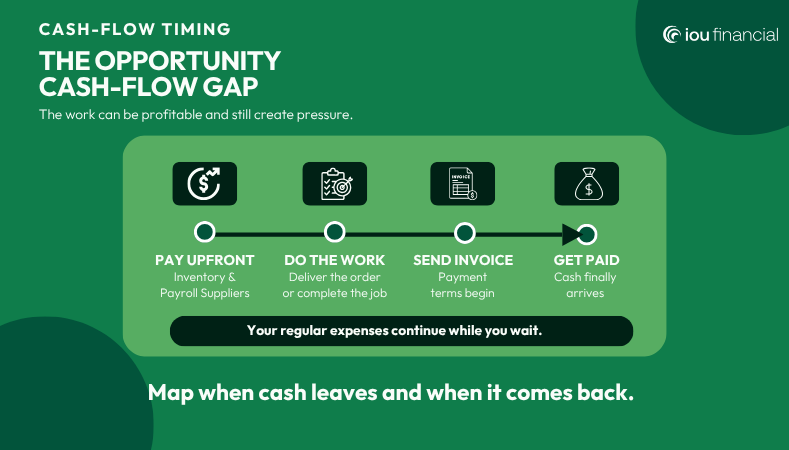
Winning the business and getting paid for it are two separate events and the gap between them is where cash-flow trouble hides.
You might finish the work this month and wait six or eight weeks for payment. If the order is large, you could be covering materials and labor long before that final invoice clears.
Map the full timeline:
- When do you need to place orders or pay deposits?
- When do employees or contractors need to be paid?
- When does the product ship or the project wrap?
- When can you actually invoice?
- What are the customer’s payment terms?
- Could approvals, inspections, or revisions push payment back further?
Then lay those dates against the cash you actually have on hand. Payroll, rent, suppliers, and utilities don’t pause while you wait to get paid and that’s exactly how a profitable deal turns into a cash-flow crunch.
Mapping cash flow for a business opportunity this way helps you see the timing gap before it begins putting pressure on regular expenses.
3. Can Your Business Actually Handle the Work?
Cash is only one piece of this. Delivering the work takes people, systems, time, and physical capacity and a contract that looks good on paper can still break your operation.
Ask yourself:
- Does your team have the time and experience this requires?
- Will you need to hire or train new people?
- Can your equipment handle the added load?
- Do your suppliers have enough inventory to support you?
- Is there enough space to store or produce what’s needed?
- Could this new customer pull focus from your existing ones?
- What happens if demand runs higher than expected?
If a big opportunity causes service problems, burns out your team, or lets existing customers slip, it may not be worth taking as-is.
Capacity trouble doesn’t have to mean “no,” though. A smaller initial order, a phased rollout, a longer timeline, or temporary help can often turn a “we can’t” into a “we can, on these terms.”
4. What Will the Business Actually Earn?
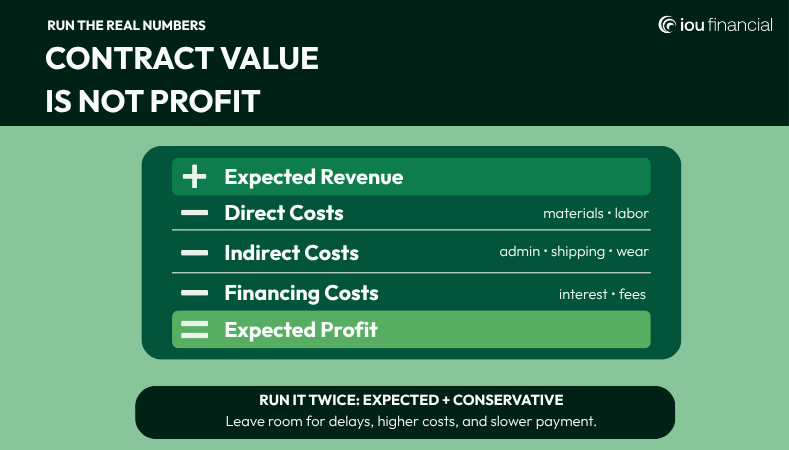
Contract size and business earnings are not the same number and conflating them is one of the easiest ways to say yes to a bad deal.
Estimate the revenue, then subtract every cost required to deliver it: direct costs like materials and labor, plus the indirect ones such as extra admin time, equipment wear, shipping, financing costs.
Then ask:
- What’s the expected profit after every expense?
- What do you need to sell or deliver just to break even?
- Is the margin wide enough to justify the risk and the workload?
- What happens if costs run higher than planned?
- What happens if the customer pays late?
Run the numbers twice: once for the expected outcome, once for a more conservative one. A simple break-even or cost-benefit analysis turns this into a decision based on facts instead of momentum. The U.S. Small Business Administration offers guidance on cost-benefit analysis, business finance management, and a break-even point calculator worth using here.
You’re not trying to predict every possible outcome, just figure out how much room there is before this opportunity stops making financial sense.
5. Can You Shrink the Cash-Flow for a Business Opportunity Gap Before You Borrow?
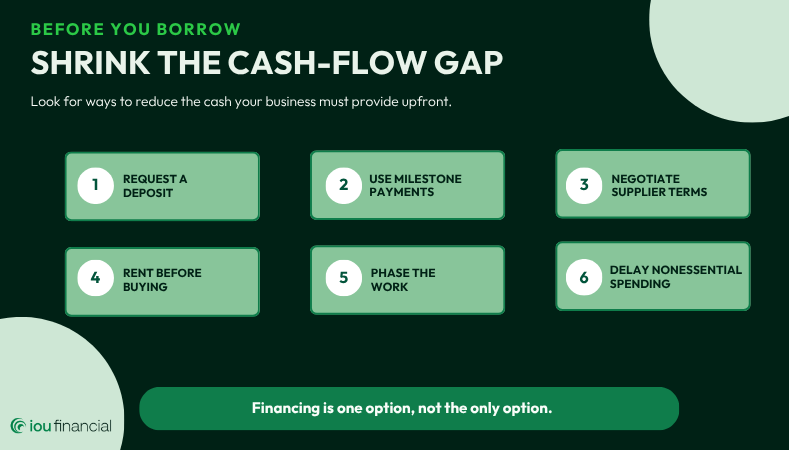
Financing isn’t the only lever available, and it shouldn’t be the first one you reach for.
Before exploring outside capital, look for ways to reduce how much cash your business has to put up front:
- Request a deposit or partial payment upfront
- Use milestone payments instead of one invoice at the end
- Negotiate longer payment terms with your suppliers
- Break a large order into smaller deliveries
- Rent equipment instead of buying it outright
- Use existing inventory or capacity before adding more
- Delay nonessential spending elsewhere in the business
- Partner with another business or subcontract part of the work
None of these may close the gap entirely, but each one makes it smaller and smaller gaps are far easier to manage than large ones.
It’s also worth asking the customer directly. A well-structured deal works for both sides, and many customers will adjust terms if it means getting reliable delivery.
6. Cash Flow for a Business Opportunity: Does Financing Fit?
Once you’ve sized up the costs, timing, capacity, and expected return, you may land on a real, specific need for working capital. If so, match the financing to that need precisely know how much you need, exactly what it covers, and how you’ll repay it.
Before accepting any offer, review:
- The total amount you’ll receive
- The total repayment amount
- Interest and fees
- Payment amount and frequency
- Length of the repayment term
- When payments begin
- Whether you could still make payments if revenue is delayed
Build the cost of financing into your profitability math from question 4. If repayment would eat most of your expected return or squeeze your regular operating expenses it’s worth reconsidering the terms, the timing, or the deal itself.
IOU Financial’s working capital solutions are built to help eligible businesses bridge exactly this kind of short-term timing gap. You can compare financing options and talk through the structure with an advisor to find what actually fits your situation.
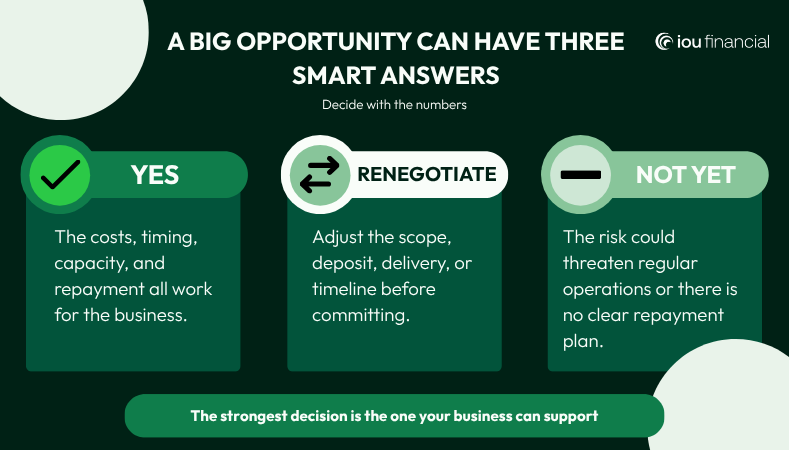
Know When “Not Yet” Is the Right Answer
Sometimes the numbers make the decision for you: the opportunity is too expensive, too uncertain, or landing at the wrong moment.
Watch for these warning signs:
- The expected margin is razor-thin
- The customer’s payment timing is vague or unclear
- One late payment could jeopardize payroll or supplier payments
- The project rests on assumptions you can’t actually verify
- You’d need to borrow significantly more than expected
- Existing customers or operations would take the hit
- There’s no clear repayment plan
Walking away isn’t a failure, it can be the decision that protects your business from an opportunity that looked better on the surface than it did in the numbers.
And “not yet” doesn’t have to mean “never.” Renegotiating the order size, timeline, deposit, or scope can often turn an unworkable deal into a workable one.
The Bottom Line
A big opportunity can fuel real growth but only if your business can actually afford to reach the revenue on the other side of it.
Managing cash flow for a business opportunity means understanding the complete cost, the payment timeline, and the risk before committing
Before you say yes: calculate the full cost, map exactly when money leaves and enters your business, pressure-test your capacity, and get a real number on what you’ll actually earn. Look for ways to shrink the upfront cash need, and treat financing as a tool for a specific, well-understood gap, not a first resort.
The best decision isn’t always the fastest yes. It’s the one that protects your cash flow, keeps your existing operations running smoothly, and gives the opportunity a genuine shot at succeeding.
Not sure if your cash flow can handle your next big opportunity? Talk to an IOU Financial advisor about working capital solutions built for timing gaps like this one.
FAQ
How do I know if a new contract will strain my cash flow?
Map the timeline of costs against the timeline of revenue. If you’ll need to pay for materials, labor, or overhead well before the customer pays their invoice, you have a gap, even if the deal is profitable on paper.
What’s the difference between profit and cash flow on a big order?
Profit is what’s left after all costs are subtracted from revenue. Cash flow is about timing, whether you have enough cash on hand to cover expenses while you wait to get paid. A deal can be profitable and still cause a cash crunch if the timing doesn’t line up.
Should I take out financing for every big opportunity?
No. Financing should come after you’ve explored ways to reduce the upfront cash need: deposits, milestone payments, supplier terms, phased delivery. Borrow for a specific, well-defined gap, not by default.
What if I don’t have the capacity to take on a big order?
Capacity limits don’t automatically mean turning the opportunity down. Consider negotiating a smaller initial order, phasing the work, extending the timeline, or bringing in temporary help.