


Why Profitable Businesses Still Struggle With Cash Flow (And How to Spot It Early)
TL;DR
Profitable business cash flow problems happen because profit and cash flow measure different things. Profit is revenue minus expenses on paper. Cash flow is the money actually moving in and out of your bank account. If customers pay 30 to 60 days after you’ve paid for labor, materials, and rent, you can be profitable and still run short. The fix starts with a simple four-week cash forecast, tighter invoicing, and, if needed, financing matched to the cause of the gap.
Why can a profitable business still run out of cash?
Sales are coming in. Your books show a profit. But when payroll, rent, and supplier payments come due, your bank balance tells a different story.
How can both be true?
Profitable business cash flow problems are common, and they almost always come down to timing. Profit tells you whether your business is earning money. Cash flow tells you whether the money is available when you need to spend it. Understanding the difference helps you spot a shortage earlier and address it before it disrupts your business.
In this guide, you’ll learn:
- The difference between profit and cash flow
- Five common reasons cash gets tied up
- Operational fixes to try before financing
- A simple four-week forecast you can build today
- When invoice factoring or a term loan may be worth exploring
What’s the difference between profit and cash flow?
Profit is what remains after expenses are deducted from revenue. Cash flow tracks the money actually moving into and out of your business during a given period.
| Profit | Cash flow | |
| What it measures | Earnings after expenses | Money moving in and out of your accounts |
| Where you see it | Income statement | Cash flow statement or bank balance |
| Timing | Can record revenue before payment arrives | Recorded when cash is received or paid |
| Loan principal payments | Not an expense, so no impact | Reduces cash |
| Owner distributions | Not an expense, so no impact | Reduces cash |
How profit and cash flow can tell different stories
Under accrual accounting, you can record revenue before a customer pays you. A profitable sale may appear on your financial statements while the cash is still weeks away.
Here’s an example. Your business completes a $30,000 project with $22,000 in associated expenses. That leaves $8,000 in profit before other business expenses.
But if the customer has 60 days to pay, you’ve already spent $22,000 on labor and materials and won’t see the $30,000 for two months. That project can create an immediate cash shortage, even though it’s profitable on paper.
The work generated a profit. The payment hasn’t arrived yet.
Using cash-basis accounting? Your reported profit will track your bank balance more closely, but the same timing gap still applies. Bills come due before customer payments arrive.
What causes cash flow problems in profitable businesses?
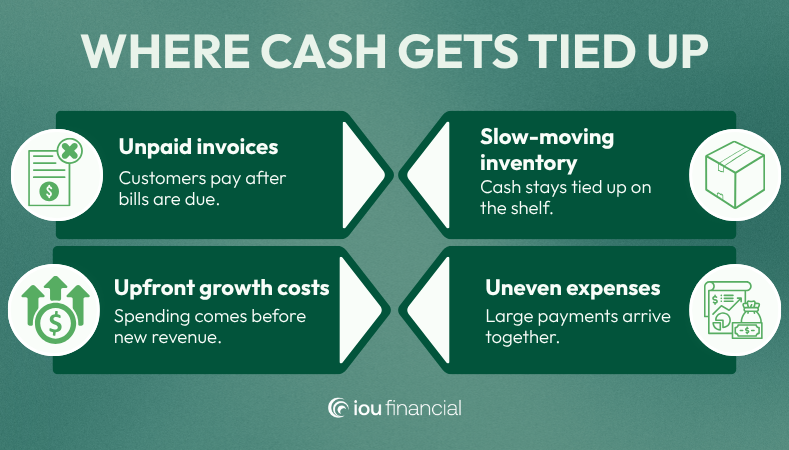
Several everyday situations can put pressure on cash flow, even when business is going well:
- Customers pay after your bills are due. Offering payment terms can mean funding weeks of operating expenses before you collect.
- Inventory sells more slowly than expected. Money spent on products stays tied up until those products sell and customers pay.
- Growth requires spending upfront. Larger orders may mean buying materials or adding staff before the additional revenue reaches your account.
- Expenses arrive unevenly. Annual renewals, equipment purchases, taxes, and seasonal costs can create a heavy spending week.
- Some cash outflows don’t appear as expenses. Loan principal payments and owner distributions reduce your cash, but they aren’t recorded as expenses on your income statement, so they don’t lower your reported profit.
- A healthy profit margin matters. So does knowing when the money will actually be available.
How can you improve cash flow without financing?
Before looking at financing, examine what you can improve inside the business.
Make invoicing easier to act on
Send invoices promptly, confirm billing details, and clearly state payment terms. Include convenient payment instructions and follow up consistently on overdue balances.
Consider deposits or milestone payments
Where appropriate for your industry and contracts, collecting part of the payment upfront or as work progresses can reduce how much you must cover before getting paid.
Discuss supplier terms before a tight week
Ask whether payment dates or installment arrangements can better match your collection cycle. Get agreement rather than simply paying late.
Review inventory and upcoming purchases
Identify slow-moving stock, recurring costs you no longer need, and purchases that can wait without disrupting operations.
Look for a repeating pattern
If the same shortage happens every month, review pricing, margins, payment terms, and spending commitments. Additional funding alone won’t correct an ongoing operating shortfall.
How do you build a four-week cash flow forecast?
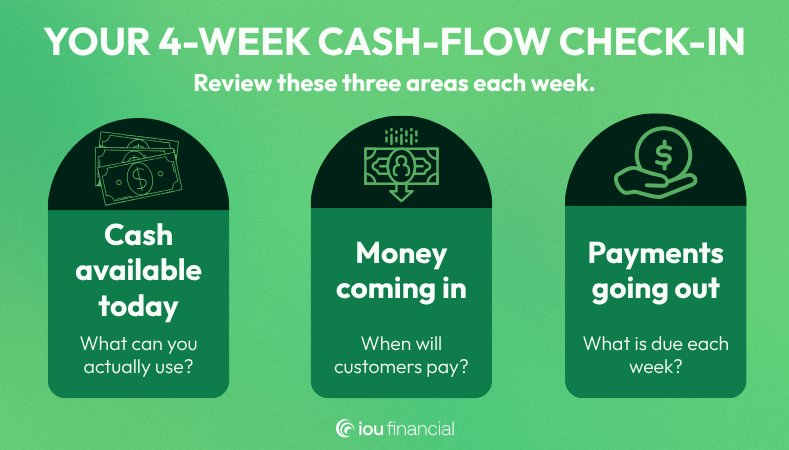
You don’t need a complicated spreadsheet to start spotting potential cash shortages. Begin with three questions.
1. How much cash is available today? Start with the money your business can actually use, not unpaid invoices or sales you expect to make.
2. What money is likely to come in? List expected customer payments and when you realistically expect to receive them. Consider customers’ payment habits, not just the due dates on their invoices.
3. What needs to go out? Map out payroll, rent, supplier payments, taxes, loan payments, and other upcoming expenses by week.
For each week, add expected incoming cash to your starting balance, then subtract upcoming payments. Carry the remaining balance into the following week.
| Week 1 | Week 2 | Week 3 | Week 4 | |
| Starting cash | ||||
| + Expected collections | ||||
| − Payroll, rent, suppliers, taxes, loans | ||||
| = Ending cash (carry forward) |
Run one “what if” test
Then test one scenario: What happens if your largest expected payment arrives two weeks late
If that delay would leave you short, you have an opportunity to follow up on invoices, adjust a purchase, or discuss payment arrangements before the pressure builds.
When is financing worth exploring for cash flow gaps?
Once you understand the cause, you can evaluate whether financing fits the need.
If cash is tied up in unpaid invoices…
Invoice factoring may be worth exploring. Factoring generally involves selling eligible invoices to a factoring company, which advances a portion of their value. The remaining amount is typically released after collection, minus fees. It differs from taking out a term loan.
Before agreeing, ask about total fees, customer communications, and who is responsible if an invoice goes unpaid.
IOU Financial offers access to invoice factoring through its partner network for eligible businesses that invoice other businesses or government entities. Availability and approval depend on business and customer qualifications. Explore invoice factoring through IOU Financial.
If you need funds for a planned expense
A term loan may be an option when you have a defined use for the money and projected cash flow that can support repayment. IOU Financial also offers working capital options for eligible small businesses; approval and terms depend on your business’s qualifications. Learn more about IOU Financial’s working capital options.
In either case, evaluate the cost and obligations against a conservative forecast, including what happens if expected revenue arrives late.
Make a weekly cash flow check-in a habit
You don’t have to wait until a payment is difficult to make to review your cash flow.
A few minutes each week comparing expected collections with upcoming obligations can give you time to follow up, adjust spending, or explore support.
Profit tells you whether your business is earning money. A cash flow forecast helps you plan when that money will be available.
Frequently Asked Questions
Why is my business profitable but I have no cash?
This usually happens because of timing. Under accrual accounting, revenue is recorded when you earn it, not when the customer pays. If you’ve paid for labor, materials, or rent before customer payments arrive, your bank balance can be low even while your books show a profit.
What is the difference between profit and cash flow?
Profit is revenue minus expenses over a period. Cash flow is the actual money moving into and out of your business. A business can be profitable and still have negative cash flow if payments arrive after bills are due.
Can a business go under if it is profitable?
Yes. A profitable business can struggle or fail if it can’t cover payroll, rent, or supplier payments on time. That’s why tracking cash flow alongside profit matters.
How do I forecast cash flow for my small business?
Start with your current available cash. Add the customer payments you realistically expect each week, subtract payroll, rent, supplier payments, taxes, and loan payments, then carry the balance into the next week. Repeat for four weeks and test what happens if your largest payment arrives late.
How can I improve cash flow quickly?
Send invoices promptly, follow up on overdue balances, consider deposits or milestone payments, negotiate supplier payment timing, and review purchases that can wait. If the shortage repeats monthly, review pricing, margins, and payment terms.
When should a small business consider invoice factoring?
Invoice factoring may be worth exploring when your cash is tied up in completed, unpaid invoices from business or government customers. Compare total fees, customer communication practices, and who bears the risk if an invoice goes unpaid before agreeing.
This article is for educational purposes only and does not constitute financial, accounting, or legal advice. Financing is subject to approval and applicable provider terms.